Episode Transcript
[00:00:00] Speaker A: Foreign.
[00:00:07] Speaker B: Welcome to Emotional Sobriety, the next step in Recovery, with Dr. Alan Berger and Tom Rutledge.
Good morning. Have you seen the Last Picture Show? That film from the 1971. It's about a dying Texas town. It's like, it's like a filmmaker from the 70s looking back to the 50s.
[00:00:27] Speaker C: Yeah, I knew you saw it.
[00:00:29] Speaker B: It's about a whole cast of characters and there's teenagers and middle aged people and elderly people too. And they're all kind of like in a mourning process for like the life that they thought they were supposed to have.
You know, the romance, you know, the crush, you know, that they. That was unrequited, that they didn't, you know, that wasn't fulfilled. I'm not going to be corny and weave it into an emotional sobriety theme, but it's very much about who are we in the face of our dreams and who we thought we would be that collapsed.
[00:01:01] Speaker C: Well, I can guarantee you when I watched it as a kid, I didn't have that kind of insight. Patrick, you know, did you see that movie with Simple Shepherd?
[00:01:13] Speaker B: Well, on that level, impeccable.
[00:01:15] Speaker A: Yeah.
[00:01:16] Speaker B: Let's start with a nutshell. I was telling Tom Allen that there's one with some meat on the bones, and then there's one funny one that I wanted to wait till you got your reaction to step 16.
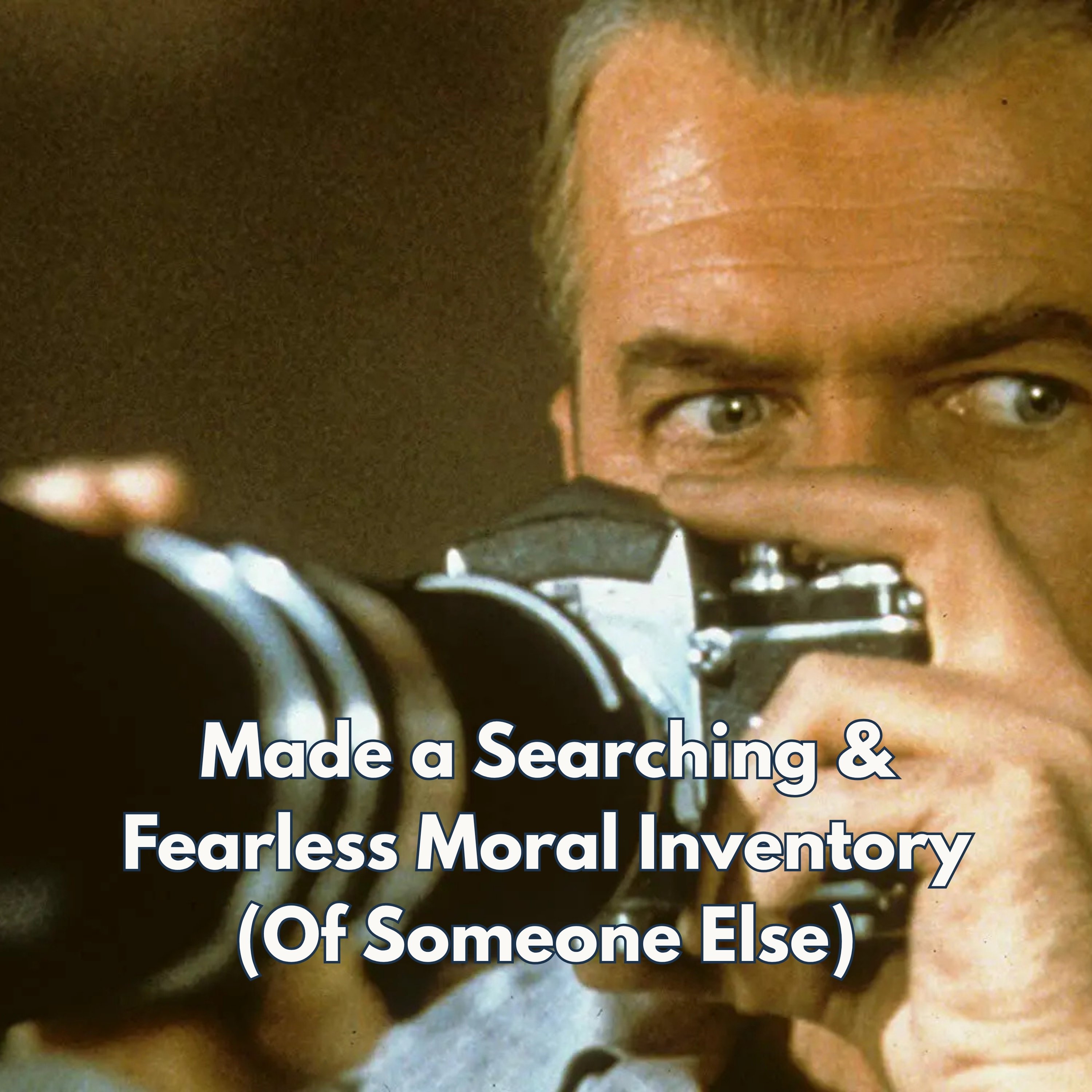
Made a searching and fearless moral inventory of someone else. I can't say I wasn't warned. They told me to stop at 12. But taking somebody else's inventory, this comes up a lot.
[00:01:37] Speaker C: That was pretty funny too.
[00:01:39] Speaker B: Yeah, they're both funny, but I thought
[00:01:41] Speaker A: that was a funny one. What's.
[00:01:44] Speaker B: Oh, wait, you guys are pretty good. Well, you're, you're trained. I mean, you're therapist. If you start doing somebody else's inventory, I imagine that you catch yourself.
[00:01:52] Speaker C: We do other people's inventories for a living. It's like, it's, it's. No, it does not make it. That does not make it easier for me anyway. It's like if we're doing good therapy, the client is always leading and we're, we're walking alongside of them, but it's, it's. Sometimes clients move slow and I kind of want to speed them up. I mean, it's, it's like, it's like. And I'm not even aware of when I'm doing that sometime. But, but you know, I kind of early on in my career, I was really aware. I became aware with some supervision that I was, you know, I had, I Had my own agenda for a client and I wanted to get them there. But everybody has. If you, if you don't think you have an issue with taking other people's inventory, you're not paying attention because everybody has that.
[00:02:39] Speaker A: What it gets to is at the heart of our functioning.
You see, we're always trying to make meaning out of our life.
We're trying to understand it.
That's how we're wired to give meaning to the experience we're having.
And if you remember the, this, the experiments that Piaget did with kids, especially in the pre operational stage of development, that really showed us how where their brain's at determines what they see, what their consciousness is like, right? The quality of their consciousness.
So what we understood, you know, when we looked at that in terms of emotional sobriety, is that our emotional development influences our consciousness in the same way.
And the more, let's say, the more immaturity I have, the more I'm going to look at the world and see the world as a reflection of me, right? I'm going to make it all.
That's why we say that we're not sick, we're stuck, because that's a very early stage of development.
It's all about me stage of development. Everybody goes through it. That's why it's not an abnormal thing. Even Freud said everybody's narcissistic. Everybody goes through a narcissistic stage of development.
We. We have to go through that. That's the way we develop. But see, then when we come into contact with the world, what's supposed to happen is the frustration of us not getting our needs met is supposed to help us mature. So we understand that it's not all about us.
Unfortunately, in our culture, it doesn't happen.
[00:04:28] Speaker B: But wait, our needs are always supposed to be met.
[00:04:30] Speaker A: What are you talking about, man? It's. How do you, how do you. How do you have a society that's.
That runs on capitalism if you don't have consumers? That's why I love the Saturday night skit with the Coneheads. I thought the Coneheads. The Coneheads, parody of capitalism.
[00:04:48] Speaker C: Weren't they mass qualities?
[00:04:52] Speaker A: That's right.
[00:04:53] Speaker B: Mass quantities.
[00:04:58] Speaker A: It was so hilarious. I would watch that and I would just say, oh, my God, yes.
But a lot of people watch that and they laugh at it, but they don't understand.
You have been hypnotized by that just like everybody else has. We've all been hypnotized by that stuff. So getting out of this, it's all about me stage of development is not easy. That's why Bill and every one of us related to this. That was in the program and we did our. Well. When I did my first step four, I kept seeing that. It just kept coming back to me. It was all about me, all about me, all about me. When I did step four, every issue I had had to do with self. Right? My selfishness, my self centeredness.
Now I realize God, because that's where I was. That's where I've been stuck at in my life.
[00:05:47] Speaker C: It was accurate. Yeah, you were getting an accurate view.
[00:05:51] Speaker A: It was, it was. And he, Bill captured something. We're all selfish and self centered in this culture. It's all about us.
Right? That's what, that's the big problem. And yeah, we strive to go beyond that. That's why being of service to people becomes such an important part is, is to get out of ourselves. But it's not just getting out of ourselves. It's maturing and realizing that it's not all about us.
See, that's the real message is that's what we're, what we understand. And Bill was really going for that with the, what he called a deflation of ego. In the end, you know, what he hoped would create this, this humility right in each person. Because each step really is a step towards more and more and greater humility. That's why the steps, you know, achieve emotional sobriety.
Because they, they, if we work them in the right way, they do right. Size us is the way. I've. I heard that Father Richard talk about
[00:06:49] Speaker C: that like that for. I've heard you use that before.
[00:06:52] Speaker A: Yeah, no, it's, it's a good concept. But let me just say something more about.
But so it's, it's normal for us to look at the world and try to make meaning of it. So if my, if I'm. My consciousness is. We'll use the term undifferentiated for lack of a better term. Maybe I'll come up with a better one right now. Meaning that I'm still stuck in the it's all about me stage of development.
When I look at the world, then I'm interpreting everything in terms of its relationship to me and looking at other people. And when they don't do what I want, I diagnose them. Because see inside me, I say, well, if they were okay, they would do what I want them to do.
That's the fallacy of it all. If they weren't as pathological, then I could have a great relationship with them because they would do everything I want them to do, and I'd be okay. See, it's that emotional dependency that comes up again.
And so, you know, Tom and I like, I love. You know, Tom, one of the things I love about you is how you shine a light on our profession. That always puts a smile on my face. Like, what other profession? I remember one time you said that she said, al, what other profession can you work in where people paid to come talk to you?
[00:08:13] Speaker C: It's a beautiful job.
[00:08:16] Speaker A: I love when you said that.
[00:08:17] Speaker C: It made me.
[00:08:18] Speaker A: It was just. You said, God, I don't need friends. People pay to come and talk about.
[00:08:22] Speaker B: To me, it's very. It's very. Dude. Like,
[00:08:26] Speaker A: we get so spoiled, Patrick, is when we have a friend say, yeah, you can come over, but it's going to cost you 75 bucks. Exactly.
[00:08:33] Speaker B: It's like, I bill by the hour.
[00:08:34] Speaker C: Well, I might have told you this. I'll tell. That's. This is perfect for that. I have a friend who loves to talk on the phone, and he lives. He lives out of state, lives in Pennsylvania. And he wants to talk on the phone. And I'm just not a phone talker, you know, And. And I've said, but. He said, but you do phone sessions. I go, yeah, when people were paying me. I'm a phone talker. And. And at one point he said. He said, oh, he thought he was making a great point. He said, if I were. If I pay you a fee, will you call? Will you talk to me on the phone? I said, yeah, I. I will. I will wake you up every morning and we'll talk as long as you want.
[00:09:06] Speaker A: It's like, good deal.
[00:09:09] Speaker B: Yeah.
[00:09:10] Speaker A: That we got so. We get so conditioned by that, by. By our profession in that way. It's. It's so. It's so weird. I remember when I first got in the field, everything in my life became a. The unit of measurement was how much I got paid for a session.
[00:09:26] Speaker C: So if I looked at.
[00:09:27] Speaker A: I said, okay, that's five sessions. That's two sessions.
[00:09:32] Speaker C: It was a new way of understanding our worth. You know, it's like, punch it.
[00:09:39] Speaker A: So crazy. It's such a crazy thing. But so when. When. When I'm giving meaning that way, I'm trying to figure out how to manipulate the world. See, when I'm trying to diagnose somebody else, like, I've got a client right now that's so focused on. They're getting a divorce, but she's so focused on fixing him, because if she. If he gets Fixed. He'll do what she wants.
And see, that's. That's the mentality.
That way, when I use.
Let me. That's not the right way to say it. When I'm looking at the world from that level of development, then I'm looking at the world to manipulate it, right? To try to make it what I want to be.
When we grow ourselves and our consciousness changes now I look at people and I try to give meaning to the experience, but I don't look at it in terms of manipulating them.
I look at that in terms of trying to have empathy with them and understand them.
And so, you know, now when I think about what's going on with someone else, I'm not doing it to figure out how to get them to be what I want them to be. I'm trying to figure out how to meet them and have the best relationship I can.
And so there's nothing wrong with us trying to figure out who somebody is.
It depends on our motives.
[00:11:04] Speaker C: Yeah, intent. This is where I always say intent. Intent counts, but it doesn't count for as much as we want it to. It's. It's. But. But it's like that, you know, that is exactly it. And it's.
Because whenever you talk about the manipulation, there's. There's a. There's another word for that. That, that. That. That we all. I think we all use regularly. And it has a different connotation to it. And. And it's strategy. It's not to say you have a. You're. You're a. You're an evil manipulator. It's to say, no, it just means you're the outside in yesterday, I was
[00:11:38] Speaker B: talking to a loved one who was in a crisis, and I didn't feel comfortable being strategic, like in the way that you described Tom, because I felt I was trying to do. What we were just talking about is I was trying to add knowledge or what I think of as knowledge to get them to act in a way that I thought would be helpful. And I think I just stopped myself at a certain point. And I think.
[00:12:04] Speaker C: I think my words are, you. You were strategic, and you caught yourself and thought, I don't think this. This doesn't feel right.
[00:12:11] Speaker B: Yeah, it doesn't feel right. And I just said, look, I just want you to be free, and I want you to be safe. And, And. And, you know, I don't think there's any knowledge I can add that you don't already have, but I'm just here for you and.
And But. But, I mean, I think that, like, without being aware of it, you know, I think a lot of times when you're trying to. You're trying to help somebody or you're kind of talking to somebody as they navigate a crisis, you're trying to. I mean, this is a. This is a way of taking somebody's moral inventory or taking their inventories. You're just trying to control things and, like, affect a certain outcome. But, I mean, well, but it's also.
[00:12:49] Speaker C: It can also be helpful. I mean, it's like, we're not. Every time. We're trying to do that. Now, sometimes maybe I'm. It's helpful, but I need to stop doing that for that person because, you know, this person is really good at getting people to do things for them.
[00:13:03] Speaker B: And it's also a great rule of thumb, you guys have both told me, is like, wait for them to ask you if they want advice about what to do.
They'll ask you for that. You know, don't, don't. Don't offer unless solicited.
[00:13:16] Speaker C: The other thing that a teacher of mine in Atlanta taught me, too, was, she said, never proceed without a contract. And the way she did that. And I do it all the time with people, but I do it a lot with therapy. It's like, is, instead of saying, let's talk about your. The we talked about your dad last week. Let's talk about your dad again. Let's do this. What she would say is. And it makes tremendous difference. She said, is it okay with you if we talk about your father some more? And then we hear that as a rhetorical question? That means I'm getting ready to start talking about your father. And so a lot of times people just sit there because, you know, and you have to stop.
This is really changing a communication strategy here or, Or.
[00:14:00] Speaker A: Or.
[00:14:00] Speaker C: Or behavior. It's like you stop and you say, no, I'm really asking you, is this a good. Does this feel okay today for us to talk about your dad again? It's like, and. And what she pointed out, and I've seen it throughout the years since I've learned this is it. It's not particularly a conscious thing to the person, but when somebody answers the door, when somebody says, yes, come on in, it's like they're a whole lot more unlikely to really get. Get the benefit of it. It's a little bit like my wife, one of the most respectful people that I know in terms of people's space, except if she's been to your house one time she was one time, when she comes to your house, she will knock at the. On the door on the way in, and she's. She's in the middle of your house before you know, she's there. I have no idea why that is, but I always think about that in terms of communication. I'm going like, whoa, where did you come from?
Because I was usually standing back at the door going, going, didi. Maybe we shouldn't. It's like.
[00:15:04] Speaker B: But it was open.
[00:15:06] Speaker C: But we do that with a communication all the time. We just. We barge in.
[00:15:10] Speaker A: The intention of our behavior becomes very important in terms of what it means. If my intention is to try to get you to do what I want you to do, then I'm acting for myself and being selfish.
And we've defined emotional sobriety as acting for ourself without being selfish.
Right.
So what does that mean? It means to be able to connect with someone and that the relationship goes to our mutual benefit means that, yes, I'm getting my needs met, but not at your expense.
Right. And to do that, I have to stay in relationship to you. I have to see you, I have to be aware of you. I need to have empathy in terms of what you're experiencing and to operate and use that to stay connected with you in that way where. The way you described it. Tom, remind me of Martin Buber's concept of an I to thou relationship.
You're seeing the other person as a subject, as another being that is not there to meet your needs that you're just having an experience with.
[00:16:21] Speaker C: Yeah.
[00:16:21] Speaker A: And the experience is. Is the goal. It's not to get something from them. It's just to be able to meet this other person and to experience that encounter fully.
And when that happens, it is intimate, man. It's incredibly intimate. It's a very powerful experience. And, you know, the thing that happens, I think, in therapy, it's a special relationship, but we create that a lot when we have people, you know, that we work with, Tom. I think we make that. That kind of an experience an awful lot in. In the, you know, in our offices and stuff like that.
And, you know, and I know a good therapist, it's not just happens in their office.
It's who they are in terms of how they live their life.
[00:17:10] Speaker C: Well, and, and I can just say to you that some of the people that I. I mean, the per. The. She's no longer with us. But, but we. Julie.
Julie Merriman and I did. Did eating disorder workshops for 25 years. We did retreats and and worked together. And I, and I don't, I don't know that Jules ever.
I think she finished high school. I don't think she ever. She might have started college, but, but she's long term recovering person, double winner, she says alcoholism and, and eating disorder. And I've never seen somebody. I'm using Jacqueline, Jacqueline Smalls term here. I've never seen anybody witness anybody who's more naturally therapeutic. She, I mean, she would, she was, she is one of the best therapists I've ever worked with, period. And it's like, it doesn't have anything. That, that part doesn't have anything to do with training. It's like. And the other thing I want to say about what you just said is.
And you're more into to what's what the research says, what study say. But the thing I've, I've grown up in this, this profession hearing over and over again is the only, the only real thing that shows up constantly through seeing what, what is effective therapy is relationship.
It's not, it's not what model of therapy you use. It's not how, how brilliant you do this little piece of, of work over here. It's, it's, it's the relationship heals.
And that's talk about, talk about a good, a good job. You know, you get to have. We're not just, we don't just have people come by and talk to. We, we get to have relationships, really deep relationships, intimate relationships for a living.
[00:18:54] Speaker A: It's.
[00:18:54] Speaker C: It's amazing.
[00:18:55] Speaker A: Yeah, it's a sacred honor, isn't it? It really is. It is a sacred honor. It really is.
But you're right about that. You know, it's funny too, in that the questions they get to assess the quality of the relationship are so basic and they're wonderful. It's like, did you feel understood by the therapist that you talked to, the counselor you talked to?
Did you get to talk about what you wanted to talk about? Things like that that are basic in a relationship? Did you feel heard? Did you feel that, that we focused on what was important to you? Things like that? And when those answers are in the affirmative, you're right. The relationship is very powerful and very, and accounts for a lot of what happens and helps people in therapy and.
[00:19:40] Speaker C: Well, two words I've written down here through a lot of things we've said and it applies, it doesn't apply just a therapy. It's a good relationship. And that is assumption versus curiosity. It's like our assumptions are like reflexes and we all make them. When you're trying not to make assumptions, tune into your curiosity, be curious about people, be curious about what's going to happen. You know, don't. For us, you know, don't assume that, you know, you met somebody one time and you know how the therapy is going to go.
[00:20:13] Speaker B: My friend's really. He loves that line. I think it's from the big book. It's contempt prior to investigation. Is that from like the big book or the 12 and 12? Yeah, yeah. But he kept repeating that the other night and describing his reticence to fully give himself to, you know, working the steps or being part of the fellowship. And yeah, I mean, I could see why it resonated with him. Because we won't know unless we look.
[00:20:38] Speaker A: Let's hit one more point before we wrap today. Patrick. See the other idea? See, Tom just reminded me of this. It's a misunderstanding of the program that we have to get rid of ourself to be okay.
[00:20:52] Speaker C: Right.
[00:20:53] Speaker A: See, there's such an emphasis, almost like the self has become a dirty four letter word.
In recovery, if you have any self, it means you're selfish and self centered and you're heading for a relapse. You're in big trouble. You got to get rid of yourself, quit, mate. You know, and there's some truth to that. I'm not saying that that's not a partial truth, because it is.
But what Tom talked about a minute ago is bringing another part of yourself into play here, into how you meet the world. And so what we're talking about is really adding, you know, let's call it your higher self, if you will. Right. Is being able to cultivate that and bringing the best of you to your life. And so it's not getting rid of yourself, it's what self you bring. Push it forward, if you will. Right. What part of you is going to be running the show? You know, like I love, you know, Tom's intrapsychic theory of, of, of. Of. Of therapy. Right. In personal development is so true. I mean, ifs is built on that model. Gestalt therapy is built on that model. You know, Tom really captured something that I think is very powerful. But you know, I love what we say is that like who's running the show?
[00:22:20] Speaker C: That's right.
[00:22:21] Speaker A: When he gets together, are they just sitting there and it's, you know, is it a, Is it chaotic? Is it like an anarchy and everybody's there and nobody's coordinated. And what we know is that when a person starts to function better, they Are those different parts get coordinated?
The part that that's runs the show, that's the leader and that takes us in a way that's going to enhance and nourish our lives rather than diminish and be toxic.
[00:22:54] Speaker C: Yeah.
[00:22:56] Speaker A: And that's what we're talking about. We want you to add that self to the picture. Right. That's going to be able to have a more intimate relationship with yourself and therefore then in more intimate relationship with others. And let's do that. Let's talk about intimacy with ourselves.
[00:23:13] Speaker B: And as a way of pointing towards that, Today's daily reflection from Joe's Beyond Belief book.
It's a quote by somebody named Ken Wilber.
In blindly pursuing progress, our civilization has in effect, institutionalized frustration. For in seeking to accentuate the positive and eliminate the negative, we have forgotten entirely that the positive is defined only in terms of the negative. The opposites might indeed be as different as night and day. But the essential point is that without night, we would not even be able to recognize something called day.
[00:23:50] Speaker C: Absolutely. Amen.
[00:23:52] Speaker A: That's the difference. See, that's the shift in our consciousness is that we don't.
Today, I don't look at frustration and disappointment as a negative.
It's once again a part of my experience of being human. And if I really dig into it, I can use that experience to grow myself.
And see, that's the whole thing is that in our culture that frustration and disappointment is once again considered to be a bad thing. And it doesn't have to be a bad thing. It's part of. It is a thing. It's a part of the human condition.
Everybody's going to experience disappointment. Everybody's going to experience frustration.
It's how we use that. It's what meaning we give to it and how we take that experience and meet that experience, or what we could say. It's the relationship to that experience that we're having that determines is it going to be of value to us or not.
Every frustration could be of value to you. Every disappointment can be of value to you. But you're going to have to go into it and allow it to happen in order to grow yourself.
There's no bypass. There's no spiritual bypass to that work.
[00:25:09] Speaker B: But we're here to story my life. Yeah. And. And you know, my alcoholism and addiction is just a manifestation of that. It's not wanting to walk through what my life was easy.
[00:25:20] Speaker A: I want to do it easy.
[00:25:21] Speaker B: I don't want to feel it. I don't want to walk through it.
[00:25:23] Speaker C: Yeah.
[00:25:24] Speaker A: Give me the. Give me the drug so I can immediately feel well.
Or give me. Give me the right exercise equipment so I can look like Chuck Norris.
[00:25:35] Speaker B: Yeah, hey, I've got the hair, but that's about it.
[00:25:38] Speaker A: Yes,
[00:25:41] Speaker C: that's true. You do. I have several magic wands in my therapy room next door, and they're just there to demonstrate that they don't work.
[00:25:52] Speaker B: All right. And hey, before I let you guys go, I thought this was funny. This was Tom's second, like, nutshell, continued awareness of all time and space, of the size and lifespan of the things around us. A grape seed in infinite space. A half twist of a corkscrew against the eternity. That's a Marcus Aurelius quote. And then Tom writes, marcus is either an authentic philosopher or he has access to some very potent mushrooms.
[00:26:17] Speaker C: I was going to say. I didn't say that first part. It's Marcus. Yeah.
[00:26:21] Speaker A: Man, Tom has really started to.
[00:26:26] Speaker C: It's like. No, but I remember thinking that when I first read that, I thought, man, that guy's tripping. It's like.
[00:26:32] Speaker B: That was your first reaction to meditations?
[00:26:36] Speaker C: To some of them, yeah.
[00:26:50] Speaker A: Sam.