Episode Transcript
[00:00:07] Speaker A: Welcome to Emotional, the next step in recovery with Dr. Alan Berger and Tom Rutledge.
Tom's nutshell for the day. So much energy we spend wishing things to be different. There are always better uses of our time.
[00:00:22] Speaker B: It takes so much of my energy to. And then I feel like I'm doing the work, right? Like. Like I feel exhausted from it. And I feel like I'm engaged in making the world better because I'm ruminating about what should be this way or what should be that way. And it is such.
It isn't a waste of energy. Like, we have to spend some time just sort of letting it all out. Right. But it's also important to limit that time. The whole serenity statement or serenity prayer idea. There is that which we need the courage to change, that which we need the serenity to accept. And where do we find the wisdom to know the difference?
And Thomas just said this in a more equally poetic, in a more contemporary way, for sure.
[00:01:19] Speaker A: Well, it's like I'm in the Fellowship of the Ring, and I'm trying to cross the mountain pass and there's some boulders that fell in my way. And, you know, I'm lamenting the boulders that are blocking me in the fellowship from getting where I needed to go rather than tunneling in a different direction.
[00:01:36] Speaker C: You've stared at the rock all day long, and you feel like you've done a good day's work.
Why?
[00:01:40] Speaker B: Because why isn't everybody else doing their share?
[00:01:43] Speaker C: Yeah, that's right. Because you're tired.
[00:01:45] Speaker D: You know, it's like the issue there is the rock is the work.
See, it's not that we've got to imagine it different, is that if we're focusing on it, the first step in emotional sobriety is to become aware of what you're doing.
See, it's not to go beyond that yet.
That's a step, a bridge too far, so to speak. The first step is to become aware of what kind of consciousness that you are wielding, that you have that. That you possess. And see that if the consciousness, if I'm so focused on the rock, just like those kids that are in the pre operational stage of their cognitive development, they can't see that the glass, the glasses that have the same amount, if they're the same size, glasses have the same amount of juice because the juice is a constant. They're just looking at the glass size because when you put a beaker next to it that's taller and. And you pour the juice and you say, do they still have the same amount of juice, they're going to say no, the taller beaker has more juice because all they can focus on is the size of the glass. They can't understand that the beaker is containing a fluid that remains constant regardless of what kind of shape of a glass it's in.
They don't get that and see our emotional development. We don't get it. The rock becomes the issue for us.
[00:03:13] Speaker C: Okay, so let's stick with that for a second though, Alan, because, because I like the beaker thing a lot because I've heard you say that before. But what you said, that really hit home for me immediately was, was the rock is the thing. And so, so and this is one of those places where we have to, you know, lower.
That's not lower expectations. It's. It's learned to, to value and respect the simple truth. It's like, like what did so in our little story, what'd you do all day, Tom? If I'm just being who I am, I stared at a rock, you know, and it's like, oh, okay, yeah, I've done that before, you know, and, but at least I'm acknowledging it for what it is. That's what I'm hearing.
[00:03:52] Speaker D: You say that if you start with that look, I'm stuck with the rock. I can't see another possibility.
That's the beginning.
[00:04:00] Speaker C: That's right.
[00:04:01] Speaker D: Only is true for us. And so many times it's hard to do that because either, you know, we sense that we should be different than we are.
See, that's back to that self acceptance that you keep beating the drum on. Tom.
[00:04:15] Speaker C: Well, it's acceptance.
It's the Nathaniel Brandon Acceptance is the first step to change.
[00:04:22] Speaker D: It's a prerequisite. It is a prerequisite to change.
And we get so busy trying to be high minded and that's great. I'm not in any way criticizing all that. I want to get there too. But the journey is not, is through the rock, not over it.
It's a weird way to say it, but I guess it's. It is what it is is, is. We got it. We got to accept I am the rock.
[00:04:48] Speaker C: We're never going to make the rock go away. I want to get rid of this. We use that language. I use the language anyway. I don't even know. I know it's not true. I want to get rid of this thought. I want to get rid of this asshole in my head. I want to get rid of this addiction. It's like, no, it's each one of those Things is a rock. It's like, no, your job is to figure out what to do with it.
[00:05:07] Speaker D: This is as an aside, but I was just came back from Grand Island, Nebraska. Grand island is the.
Is the center for the Central Nebraska Council on Alcoholism and Addiction. They have a annual conference and I've been invited to speak there several years. And so two years ago I spoke for them. And it was just when my book came out, just after my book came out and somebody in. In One of the AA meetings who we had about 28 years sober at that point find my book. It wasn't that you didn't come to the conferen, but he brought it, he read it and he. And he says, oh my God. And we're seeing this so much. Tom and Joe, you guys both have heard it too.
Is. He said, my God, emotional sobriety.
Where has that been? I mean. And you know, it's like, wow, it's right there, guys. It's right. It's so obvious. It's in front of us. We can't see it.
[00:06:00] Speaker C: Hiding in plain sight.
[00:06:02] Speaker D: Absolutely in plain sight. So they started two years ago, they started two emotional sobriety AA meetings.
And they have just taken off. And so when they heard I was coming, they invited me to come to speak at this AA meeting.
And this is how powerful this thing has gotten. They had to get the women's meeting to have a group consciousness, to give up the clubhouse, the Alano clubhouse, for me to speak that night.
And the women decided to do that.
And a lot of the guys are saying, man, that was a first that they decided to cooperate with us in that kind of a way. And they loved it, right? And so I show up.
It was planes, trains and automobiles getting there and especially.
But I show up at a quarter till seven, I'm supposed to speak at seven. I walk in there, there's 100 people there from Grand Island. It's probably half the population.
No, it's big. Grand island is bigger than that. It's quite a big city, actually.
But it was. The reception was incredible in terms of what it means to them to start learning about this stuff.
And it's wonderful. I can only imagine it's almost like what people were discovering when they first went to AA meetings back in the 30s.
Like, look at how wonderful this is. That's how people are discovering emotional sobriety right now.
[00:07:28] Speaker C: Look at, look at Bill's prophecy when we read that every Thursday night. It's like this. This may be the next frontier. It's. It's like I Don't know. I mean, the man was, among other things, in my opinion, psychic. And, and, and, and, and so basically, who knows what the lapse is? But, you know, because, because like, I've learned that from you, Alan. It's in, he wrote it a long time ago. It's been in the, in the literature the whole time. And it's like, but there's definitely a thing where this is now happening. And it's like, it just, it almost seems like somewhere it's being managed. It's like, but it's, it's, it's, it's certainly here and present and acknowledged fully now.
[00:08:09] Speaker D: It's true. It's, you know, I asked at the beginning of the meeting, how many of you know that the outcome for working their steps is the achievement of emotional sobriety.
That is specifically stated by Bill. Not one of them raised their hands. And then I read them that, that last sentence from that in, in step 12, right when Bill was saying if we practice the, these principles in our daily affairs, that we and those about us find emotional sobriety, it's like people haven't heard that and like it's hiding in plain sight. Tom, I'll. Yeah, until about 25 years ago, I read that too, and it never registered to me. It's like I just passed it by.
[00:08:51] Speaker C: It's almost like there was a spell on it there. Nobody was going to get, nobody was going to say it. And I mean, it just seems magical to me. It's, it's really cool.
[00:09:00] Speaker D: It's so true. I, I was one of those guys that just passed it by until, until something happened. And then it hit me, my God, you know, and I started to see all of the connections to all of these different therapies, man, all the things that we're talking about.
[00:09:18] Speaker A: Well, it's a, it's a subtle thing, but I think one of the hooks about emotional sobriety early on that really got to me was I was talking to you, Alan, about like, well, I'm worried if this or that happens, it might take me out. Like, my mentality was, is that I needed to avoid these life events like potholes, because that would be the thing that would endanger my recovery. And then, you know, the way you kind of helped reorient me was just like, no, it's like, it's more about, like, the potholes will happen.
And then you organize, you reorganize yourself around that. You know what I mean? It's not about avoiding calamity. It's about when the calamity hits you, then how do you change the way that you think about it?
[00:10:03] Speaker C: Yeah, don't aim for the potholes, but when you. When you hit them, and we all will, it's how you respond. Alan says this all the time. It's how you respond.
[00:10:12] Speaker D: If you process and digest those experiences in the way. That's why people talk about post traumatic growth now, not just post traumatic stress. Right.
That's the shift is to see, you know, positive psychology brings a lot of that to the foreground. But. But that, you know, we've been talking about this and other people have been talking about this for a long time. Virginia Satir really was. We could even say that she was the grandmother of emotional sobriety in many ways. When you look at her writings and. And the way that she looked at life, man, was very inspiring.
[00:10:47] Speaker A: So Tom has another nutshell that I pulled. Anxiety is consistent and persistent and disciplined. It wakes us up first and works out every morning.
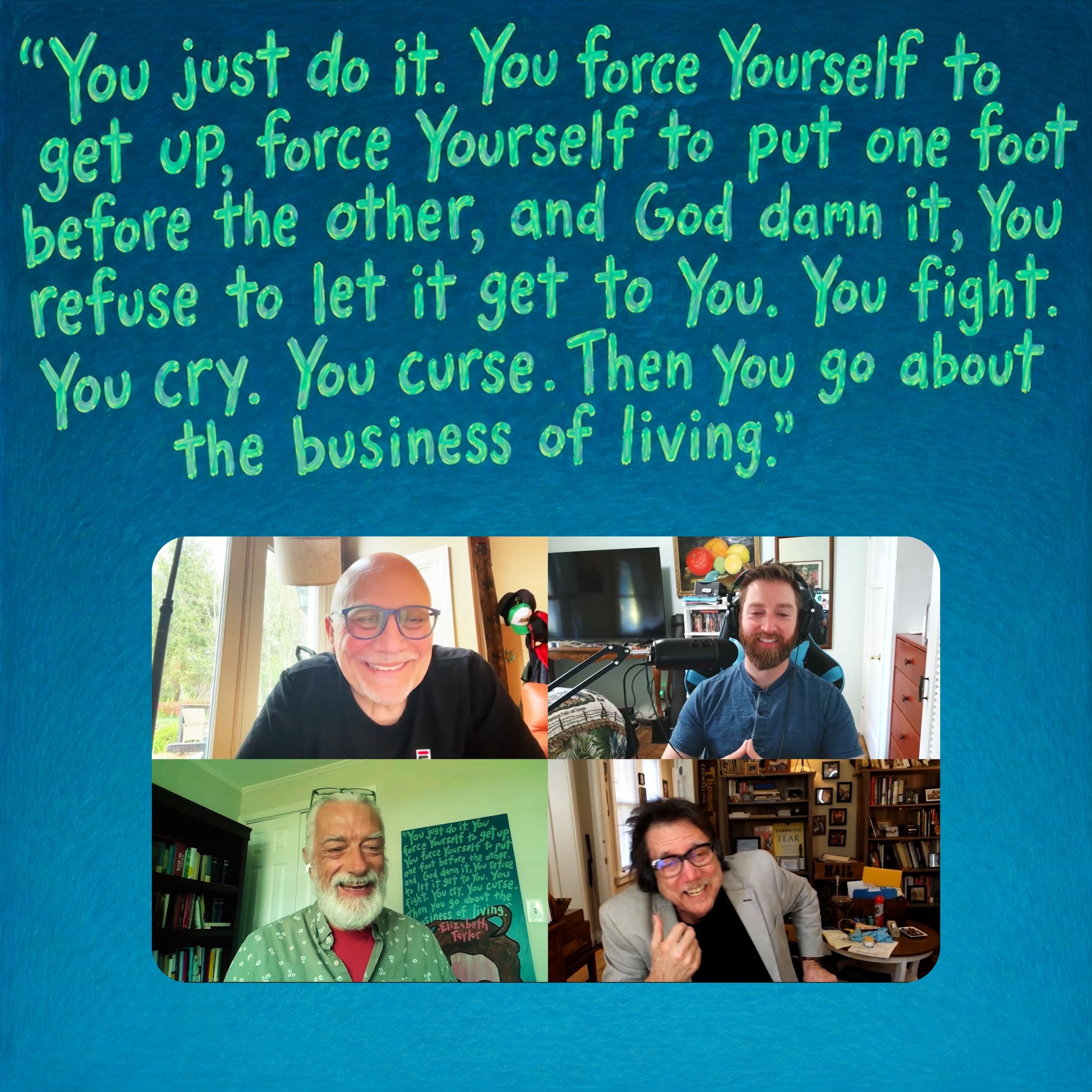
To change, we must be at least as disciplined. And then I was thinking about that, and then I saw behind you, Joe. And you have this idea of meeting anxiety with discipline. You just do it. You force yourself to get up. You force yourself to put one foot before the other, and God damn it, you refuse to let it get to you. You fight, you cry, you curse, then you go about the business of living. And so this idea about an emotional sobriety, meeting anxiety with discipline, and. Oh, and that's Elizabeth Taylor. And there she is.
There's some kismet, I think, in those two things, meeting each other. But maybe let's start with Joe, like, you know, meeting anxiety with discipline is. Is that a practice you've observed in your recovery?
[00:11:44] Speaker B: Well, I love the idea that it's going to take work, right. You know, like, you have to be able to deal with what is not what you want it to be. Right. And part of that is, you know, I've got an inner critic, for instance, that is relentless. Gets up before I do, has a list of things to cover the minute I am conscious. Right. And follows me around all day. Right.
You know, people overuse, but use that my alcoholism is in the parking lot doing pushups kind of idea. But I think they're trying to, in their own poetic way, get to the same thing. Right. We are up against something.
You know, here's another expression I heard in a meeting once.
My brain would kill me if it didn't need the transportation.
[00:12:40] Speaker D: Say that again, Joe. I never heard that, Joe.
[00:12:44] Speaker B: Say that again, Tom, I knew would love it the most. My brain Would kill me if it didn't need the transportation, needs my body to move it around.
[00:12:53] Speaker C: I mean, that's it. I'm going home. That's enough. I've worked enough today.
[00:12:58] Speaker B: This is one of the things that peer to peer or mutual aid helps is the hope to overcome an overwhelming task that has in many ways defeated us before.
We don't muster that hope.
We catch it from other people who are already in recovery. It's contagious. Hope is contagious. And once we have that hope that comes from other people in recovery, say, emotional sobriety.
We're contagious. And we can't help but spread it to others as well.
And so there was an expression in a meeting I really loved. It was part of their preamble is, we're not here to take your pain away, but you're never going to have to go through it alone again.
And I like that, you know.
[00:13:54] Speaker D: Touches me too. You know, I've been thinking a lot about anxiety and I'm starting to rethink it in some ways.
And, and it was inspired by something Rollo May said.
Rolo May was a brilliant psychologist.
He brought existential humanistic psychotherapy to the United States.
And it's just such a very grounded. And, you know, it's. It's based on existentialism, right? It's. It speaks to where we live, our existence, right? Where we experience our existence.
And one of the things he said, he. He got in touch with what anxiety meant when he was in a sanitarium for treatment of tuberculosis. He had tb.
And what he saw was there, everybody there was so anxious. And he realized the anxiety was because everybody was experiencing a threat to their very existence and that the anxiety was the fear of being nothing.
It's the way the existentialists say these things, which is really touching and powerful, isn't it? The fear of being nothing.
[00:15:07] Speaker A: Wow.
[00:15:07] Speaker D: It's very powerful, right? And so what I have been thinking about is that the way this works with emotional sobriety is when we generate these expectations, we base our existence on the world cooperating with these ideas we have on how things are supposed to be.
And when they get challenged, meaning when someone. Life doesn't cooperate with what we want it to be, expected to be, hope it would be, and all those other things, then the greatest fear we have is we're nothing. You see? And I think that's what makes the reaction to it so profound and so challenging to deal with, because that's all of our greatest fear.
See, we're not afraid of death is what the existentialists say. We're afraid of being nothing.
That's the issue. Death, like, equals nothingness to us.
[00:16:06] Speaker B: Yeah, it's the same.
[00:16:08] Speaker D: Right. And it's such a different way of starting to think about this stuff.
So if my being someone or something has to do with depending on the world being a certain way, then my sense of self is very vulnerable and fragile. It can be influenced and challenged at the drop of a hat, the wink of an eye, the turning away of a face. I mean, all of these things can make me incredibly reactive to my environment.
But when we take that center of gravity back into ourself. And, Tom, this is one of the things that we are really working with people on when we. When, like, when you approach them from the intrapsychic, you know, model that you've developed and from Gestalt, we're helping people develop a sense of self that is beyond the environment.
[00:17:08] Speaker C: It's not dependent.
[00:17:09] Speaker D: Yeah, yeah.
[00:17:10] Speaker C: It's not. It's not conditional.
[00:17:12] Speaker D: Yeah, it's. It's not. Conditional is we're moving towards a sense of self that is based on our relationship with ourselves. And this is another term I want to bring in.
I'm reading another Geshel therapist by the name of Dr. Jerry Greenwald. He's passed away now, but he was at UCLA, where Brandon went to school, too. So Brandon was there, Greenwald was there, the guy that developed the paradoxical theory of change, Arnold Bizer, was there. I mean, a lot of people that were really influenced because Fritz Perls came to UCLA back in the 60s and gave a lecture. And when he gave this lecture, it's like, it had a big impact on people. They started. A lot of people really just said, wow. I mean, to the point where Gestalt Institute started to pop up in Los Angeles, all over the place.
So this is where I was tying this to. I was talking about Greenwald, and he has this concept.
We talk about the relationship with self. You know, what he calls it, the intimate self, is if our development is in the trajectory that it can be right in terms of what's possible, then we develop a very intimate relationship with ourself, which means that we're nourishing, which means that we're on our own side.
Right. It's the things like Brandon talks about self acceptance. Well, the intimate self is based on paying attention to. Is what I'm doing enhancing my experience in life and nourishing myself, or am I subtracting from myself? I mean, I thought it was a great Concept. And he says without that intimate self, it's impossible to have an intimacy of two.
[00:19:03] Speaker C: Absolutely. That's beautiful. The best way for me to be available and helpful to you guys or my clients today is to be to take good care of myself. That's, that's the number one thing. It's like if I want to, if I want to take a trip across country, I need to be sure my car is in good shape to go. It's not that. Is that selfish? Yeah, it's self focused so that I can get this done. But we have been taught that, that, that love always has to equal sacrifice, you know, and it, and you know, when I, when I correct people all the time say no love. Love includes the willingness to sacrifice when it's needed, you know, and, and, and the truth is it is how we love when we need to. If I, if I need to give up something to help Joe do something that's really important to him, I will do that. And, but, but it's not, it's not really a sacrifice because it's just me doing what I choose to do. But it's like we, we, we just, we. It's like it's not enough that we help other people. We have to lose.
[00:20:02] Speaker D: Yeah. Well, I love the way Brandon reframed that. Tom. I was reading in his book the Psychology of Romantic Love and he said it is of selfish interest for, of.
For me that someone I care about operates in their, in their well being, for their well being.
So if I can do something that will help you, it's not a sacrifice because it's of interest to me for you to be okay. I love you, I care about you.
And see, it can grow my value system. Yes, exactly.
[00:20:40] Speaker C: Yeah.
[00:20:41] Speaker D: It's not a sacrifice. It's an expression of what is important to me. You're important to me. I want you to be happy. I want to please you. And see, we get that confused. So people think if you expect express that you're codependent. No, you're not. Where you're codependent is if you lose yourself in doing that. Right? If you lose yourself in doing that, there's a problem.
But not when you stay grounded. And I'm doing this because I care about you and I want you to feel happy. I want to please you. I want you to enjoy your life.
[00:21:14] Speaker A: You bring it back to the I. Yeah. I mean, lately what we've been talking about is really been helping me at work because every day I come into work and I need to relocate the emotional center of gravity inside myself because my boss has been really unhappy lately. He's been really pissed off and it's. I have the easy tendency of letting him being upset about things mean that I am now upset, you know, or that, like, you know, some, there's some absence, external absence that I now make, you know, my failing.
And, but the thing is, is that, like, I am suiting up and showing up and I'm just trying to do everything humanly possible to, you know, be of service and to, to be of use in that situation. And then the rest, I've got to just leave it. But like, yeah, it's. I, It's a fight every day for me to, to keep that emotional center of gravity in me rather than to make it, you know, however the whims of, or however this person's feeling every day.
And you know, it's probably a common
[00:22:26] Speaker C: thing with work, but, you know, there's all, you know, I, I associate this with you, Alan, from early, early on with us talking about that, and that is that emotion. And I don't know what book it was that you first talked about it because I think you probably haven't more than one of your, your books. But, but that, that emotional sense of gravity and, and, and, and you know, and then just being. When you. We were actually in the same room together at times, just you talking about that with the advantage of just showing, physically showing, you know, what, you know, as a, just as, as a, as a Marine and as a tennis player and all these things just show what you do with your body that just, it just is so, it's so tangible about, you know, that, that. And, and I mean, I'm more, more aware of that now ever. Because ever since I went through my chemo treatment and stuff like that, my balance has never been exactly the same since then. It's like, and that's better. But it's, it's like I've, you know, I never experienced the idea of being off balance physically, but. But I have now and it's. And I think about you and your fit. I actually you're, you're a role model for me in my, you know, so that I can see myself in the position you would put yourself in so that I would be able. So I say I need to do this. And I, and it's, it's a priority. I need. I need. So physically it's true, but emotionally it's also true if I'm off balance, I need. It's worth my time to stop and get balanced Become balanced.
[00:23:50] Speaker D: I had so much trouble getting back from grand island because it had storm in Chicago this last weekend. Yeah, I get, I get to the airport on Friday morning 6am and I've got a, an only an hour in between connections when I get to Chicago to get to Philadelphia and they, they delay the flight from grand island to Chicago by a half an hour because of the storms going in there, right. And so they offered people to come off the plane because the plane had too much weight on it. And I volunteered because I wasn't going to get there anyway. So I ended up, you know, they move me to six o' clock at night so I end up sleeping on the floor at the airport in the morning, right.
I find a corner in the airport and I go to sleep. They throw my jacket over me and then at 6 o' clock they cancel the flight to Chicago. So I'm now in grand island. You know, Friday night get to the airport at 6am but thank God we transferred me through Denver this time. But by time I got home, it was 6 o'. Clock. So I had been traveling for 36 hours, Tom. Talk about spent. I felt like I had been traveling for a year. I swear I was so exhausted, man, I was fried on Saturday night.
Just fried my. I just don't, I don't have that resilience that you talked about, you know, it's just the same and it's just not there is. Is I used to be able to do that and you know, and I, I think back, you know, 30, 40 years ago, that would have been nothing.
[00:25:24] Speaker C: You think about all the we could do. I mean I.
Taking. Taking a trip where you're driving through the night, you know, it's just, it's, it's like how many I just did. You did that because it was Friday.
[00:25:35] Speaker D: You know, it's like an hour and a half to get to my appointment at the VA Medical center yesterday almost.
[00:25:41] Speaker C: This is, this is off subject. So, so palace. You may need to just, just edit it out. But, but you remind me when you say that a guy that taught me how to. How what it meant, how to set fees for my, my speaking engagement. Because, because I always said, I don't understand. It doesn't seem to be a standard. And it's like why would I get this much money for speaking for 45 minutes, you know, and this kind of stuff. And, and this guy said to me he'd been doing this a long time. He said, no, you don't, you don't, you don't charge for speaking. He says you charge for being stuck in that airport in Rochester. He says you, and you're talking about it. He says you charge enough so that when that happens, you don't feel resentment. It's like he said, that's how you set your fee.
And it really has worked. You said it and you go, okay, I'm getting paid for it. But it really helped me to reframe it and realize, well, of course I'm not getting paid to talk to these people. I thoroughly enjoy that.
[00:26:34] Speaker B: They say it in the plainest terms in attachment theory.
And people are either have healthy attachment or unhealthy attachment. And maybe in our circles there isn't so much of that healthy attachment thing.
[00:26:49] Speaker D: But.
[00:26:50] Speaker B: But someone with healthy attachment expects a partner to help them and help meet their needs. And they expect to help their partner and help meet their needs. It's just that there isn't any wall. There isn't any, ooh, that's, you know, the language of, you know, codependent. Just because it's natural for them. We're in a partnership, we're looking out for each other and you're looking out for me and I'm looking out for them. And that can expand to, you know, being able to keep your shit together in a 12 step business meeting or at the floor of an area assembly. When there's a lot of other people who feel differently about a topic than I do. For instance, it goes back to that boulder, right? You come up to the boulder. You know, half of the group says, we have to move the boulder. Someone else says, let's just go around it, right? But, but a lot of people feel so strongly about it's got to be this way or it's got to be that way. When it's just, you know, let's work together what works for you, you know, that kind of thing. But yeah, emotional sobriety. And we were talking about hiding in plain sight.
The language in the steps is having achieved a spiritual awakening.
And I honestly don't know what that means to you three, right? Like it's one of those words isn't a good word to get connection on because it means something different to everybody. But when people describe their spirituality, they're often describing their emotions. Awe, wonder, dread, right? Existential angst. Those are all emotions and they seem to be of great spiritual interest.
But it includes everybody. If we talk about having achieved an emotional awakening. Because that's what Bill was talking about, right? The ability to be centered in ourselves, to have room for others around me right. That seems to be it. It's a better word, you know, in a practical sense. Right. Without getting into the fun of is there or isn't there or what, what's my meaning and what's the universe and all that sort of stuff. But in practical terms, that is what we're trying to achieve. To be centered in me and to live in the world,
[00:29:49] Speaker D: Sam.